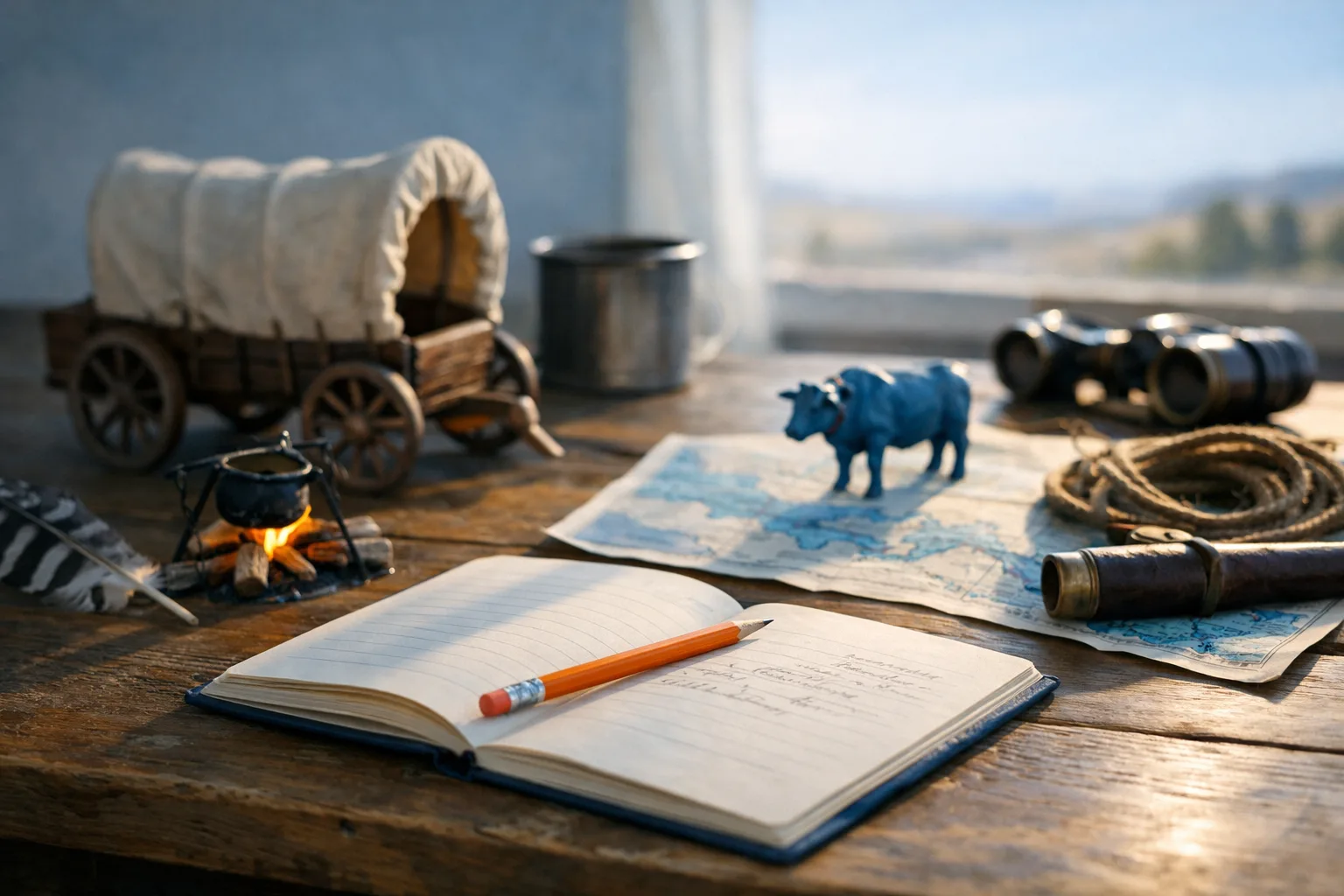
Few settings give a young writer as much to work with as the Oregon Trail. There are rivers to cross, wagons to repair, weather to survive, and a real destination at the end. A story set on the trail asks your child to blend facts with imagination, which is exactly what historical fiction does. This project takes six sessions of about 30 to 40 minutes, and it works well for grades 3 to 5, with more support for third graders and more independence for fifth graders.
Before you start: a few facts
The Oregon Trail was an overland route of roughly 2,000 miles (3,200 km) that began near Independence, Missouri, and ended in Oregon’s Willamette Valley. Tens of thousands of settlers traveled it in covered wagons, mostly from the 1840s through the 1860s. The trip often took four to six months, and the families walked beside their wagons much of the way because the wagons were loaded with supplies and the ride was bumpy.
The National Park Service cares for several sites linked to the trail and posts historical material on its website. A librarian can also point you toward picture books and children’s nonfiction on pioneers. Read a bit together before session one, and let your child jot down three things that surprised them. Those facts will become story details later.
Session 1: Research quickly
Keep this session short. Your child needs a handful of reliable details, not an encyclopedia. Make a simple list in a notebook under four headings: Food, Danger, Daily work, and Weather and land. Under each heading, write two facts. For instance, under “Danger,” your child might write “river crossings” and “lost wagon wheels.” Remind them that the list is a toolbox, and they do not have to use every item.
Session 2: Create a character
A good story begins with someone the reader cares about. Ask your child to decide:
- Name and age. Fifth graders may want a character near their own age.
- Where the family came from and why they are heading west.
- One thing the character is afraid of.
- One thing the character wants more than anything.
The fear and the want matter most. They turn a trip into a story, because the trail will push against both.
Session 3: Plan with a beginning, middle, and end
Have your child fold a sheet of paper into three sections and sketch or write in each:
- Beginning. The family leaves Independence, Missouri. Show who the character is and what they hope for.
- Middle. One big problem on the trail: a stormy river crossing, a broken axle, a shortage of food, or a lost animal. The character tries to solve it, and the first attempt fails.
- End. The problem is solved, and the character has changed in some small way.
Younger writers can stick with one problem. Older writers may add a second small problem before the main one.
Session 4: Write the first draft
Let your child write without stopping to fix spelling. The first draft is for getting the story out. Remind them to start with action or a vivid detail, not with “My name is…” and to use at least two senses in the middle section: the smell of wood smoke, the creak of the wagon, the dust on a tongue. Grade 3 can aim for a page; grade 4 for two pages; grade 5 for two or three.
If your child is stuck, ask them to tell you what happens next, then write only the first sentence of the answer.
Session 5: Revise
Revision is not the same as proofreading, so tackle the big pieces first. Read the draft aloud together and ask:
- Does the beginning tell us who the character is?
- Is the problem clear, and does the character try something?
- Where could one more detail help the reader see the scene?
- Did a historical fact slip in wrongly? If you are unsure, check it.
Choose two changes and make them. Resist the urge to rewrite the whole piece. Children learn that revising can be small and still make a big difference.
Session 6: Proofread and share
Now look at capital letters, ending punctuation, and spelling. Reading the story backward, one sentence at a time, helps catch errors, because the child is not carried along by the plot. Then copy the story neatly or type it, add a title and a cover drawing, and hold a reading for the family. A grandparent on a video call makes a great audience.
Ideas to deepen the story
If your child finishes early or wants to keep going, a few extensions add depth without adding stress. One option is a map: draw the route from Independence, Missouri, toward Oregon and mark the spot where the story’s big problem happens. Seeing the distance on paper helps a child understand why the trip took months.
Another option is a set of “what would you pack?” choices. A wagon could carry only so much weight, so families had to decide what mattered most. Ask your child to list ten things the character brings and explain why each one earned a place. The list can become a paragraph in the story, and it quietly teaches the idea of trade-offs.
A third extension is a diary entry. Pick one day in the middle of the journey and write it from the character’s point of view, with the date, the weather, and one worry. Diary writing is short, personal, and a nice change of pace after a long draft. It also gives the quieter details, such as the creak of the wheels or the taste of dry biscuits, a place to live.
Finally, remember that real history includes the people already living along the route, whose homelands the trail crossed. A thoughtful older child may want to include that perspective or at least to ask how the story would sound from another point of view. Reading a short passage from a library nonfiction book can start a good conversation.
What your child gains
The project touches planning, drafting, revising, and publishing, the same cycle teachers use in class. It also connects reading and history in a way that sticks. If your child loved the project, look for other settings in the reading and literacy section, where we suggest books that pair well with story writing. For extra fun, add one letter a character might write home, or a diary entry from the middle of the journey.
Whatever the final story looks like, praise the effort and one specific detail you liked. “I could feel the cold river on my feet” does far more than “Good job.”
Leave a Reply