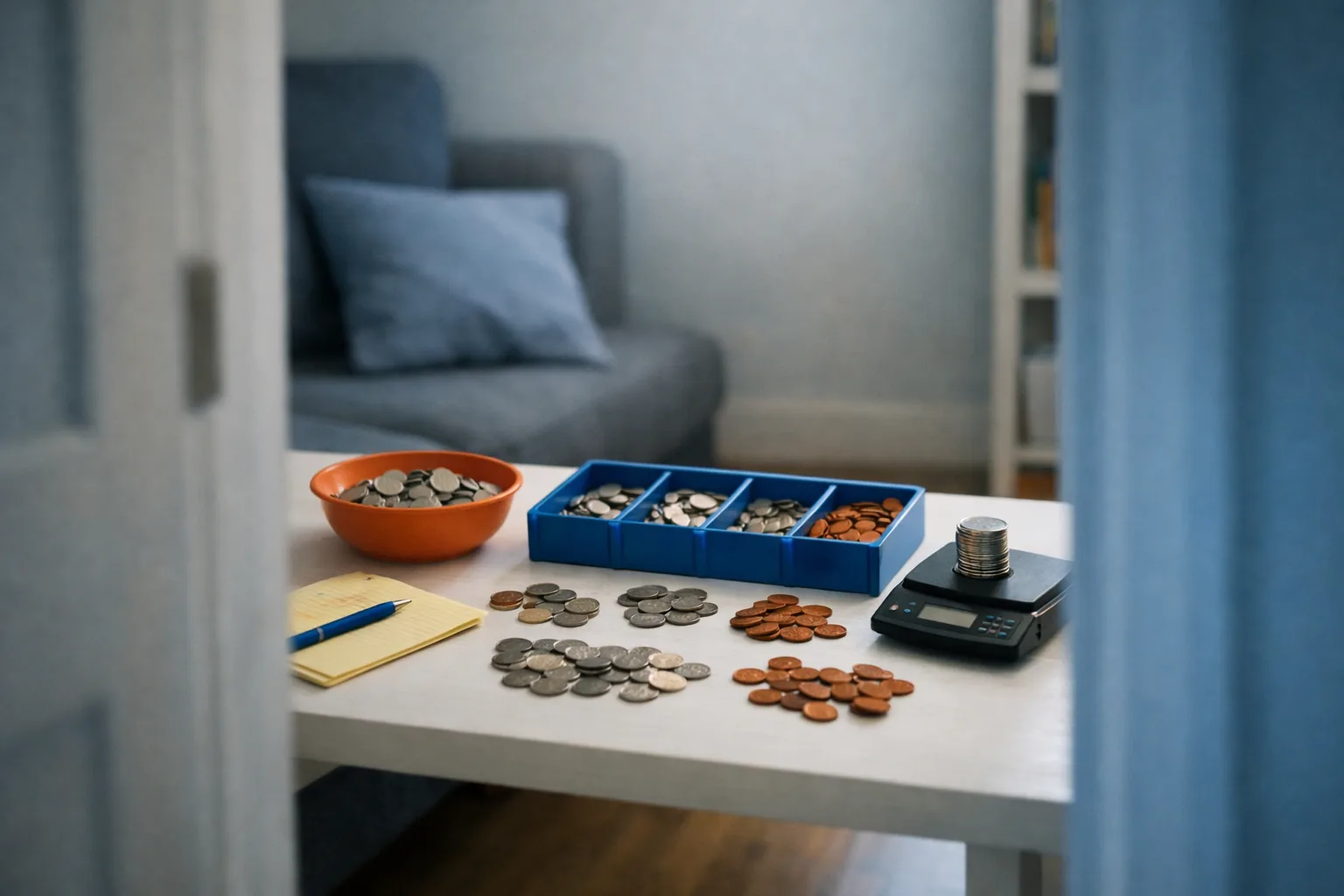
Counting money is one of the most useful math skills a second grader learns, because it comes up in real life every day. It also pulls together skip counting, place value, and addition. The coins themselves are made by the United States Mint (U.S. Mint), and you probably have plenty in a jar at home.
Meet the four coins
| Coin | Value | Nickname | Practice question |
|---|---|---|---|
| One-cent coin | 1 cent | Penny | How many pennies make a nickel? |
| Five-cent coin | 5 cents | Nickel | How many nickels make a dime? |
| Ten-cent coin | 10 cents | Dime | How many dimes make a dollar? |
| Twenty-five-cent coin | 25 cents | Quarter | How many quarters make a dollar? |
Note that the dime is smaller than the nickel and the penny even though it is worth more. Let your child hold each coin and notice that size does not tell you value. Look for the words on the coin, too. “One cent” is written on a penny, but the nickel and dime say “five cents” and “one dime.”
Week 1: sort and name
Dump a handful of coins on the table and let your child sort them into four piles. Name each coin and say its value. Play “mystery coin”: put a coin in a sock and have your child feel it and guess which one it is.
Week 2: count by skipping
Teach the skip-counting patterns that go with each coin: by fives for nickels, by tens for dimes, and by twenty-fives for quarters (25, 50, 75, 100). Then count mixed groups. The trick is to start with the biggest coin and finish with the smallest. For example, a quarter, a dime, a nickel, and two pennies: say “25, 35, 40, 41, 42.”
Week 3: make the same amount different ways
Ask, “How many different ways can you make 30 cents?” Your child may find a quarter and a nickel, three dimes, or six nickels. This shows that the same value can be built from different coins, which is useful for later math. Write each combination down to keep track.
Week 4: play store
Set up a pretend shop with household items marked with prices under a dollar. Take turns being the shopper and the cashier. The cashier counts the coins and tells how much change should go back, by counting up from the price. If a snack costs 35 cents and the shopper pays with a dollar, counting up goes: 35, 40 (a nickel), 50 (a dime), 75 (a quarter), 100 (a quarter). Fun and real.
Common stumbling blocks
Second graders tend to trip over the same few things, and knowing them in advance saves frustration.
- Nickel versus dime. The dime is smaller and worth more, which feels backward. Keep both coins in hand and compare them side by side until it clicks.
- Switching counting patterns. Moving from counting by 25 to counting by 10 is hard. Say the new pattern out loud before you start, such as “Now we count by tens.”
- Losing track. Have your child touch each coin once as it is counted, or slide counted coins into a separate pile.
- Writing the amount. Show the cent sign and the dollar sign, and practice writing 75 cents as 75¢ and $0.75. Do not rush the decimal form, since many schools introduce it later.
Extra games for rainy afternoons
Try “coin toss totals”: toss a handful of coins onto a tray, then count only the coins that landed heads up. Or play “fewest coins”: name an amount like 41 cents and see who can make it with the fewest coins. The answer is a quarter, a dime, a nickel, and a penny. These puzzles push children to think about which coin goes first.
Keep it relaxed
Ten minutes a few times a week is enough. Allow your child to use a chart if coin values slip, and wean off it slowly. If a concept like regrouping 100 cents into a dollar seems tricky, ask the teacher how the class is writing money amounts. You can see how stories and writing mix with math in our Writing and language section, where a shopping list makes a good writing task.
Leave a Reply