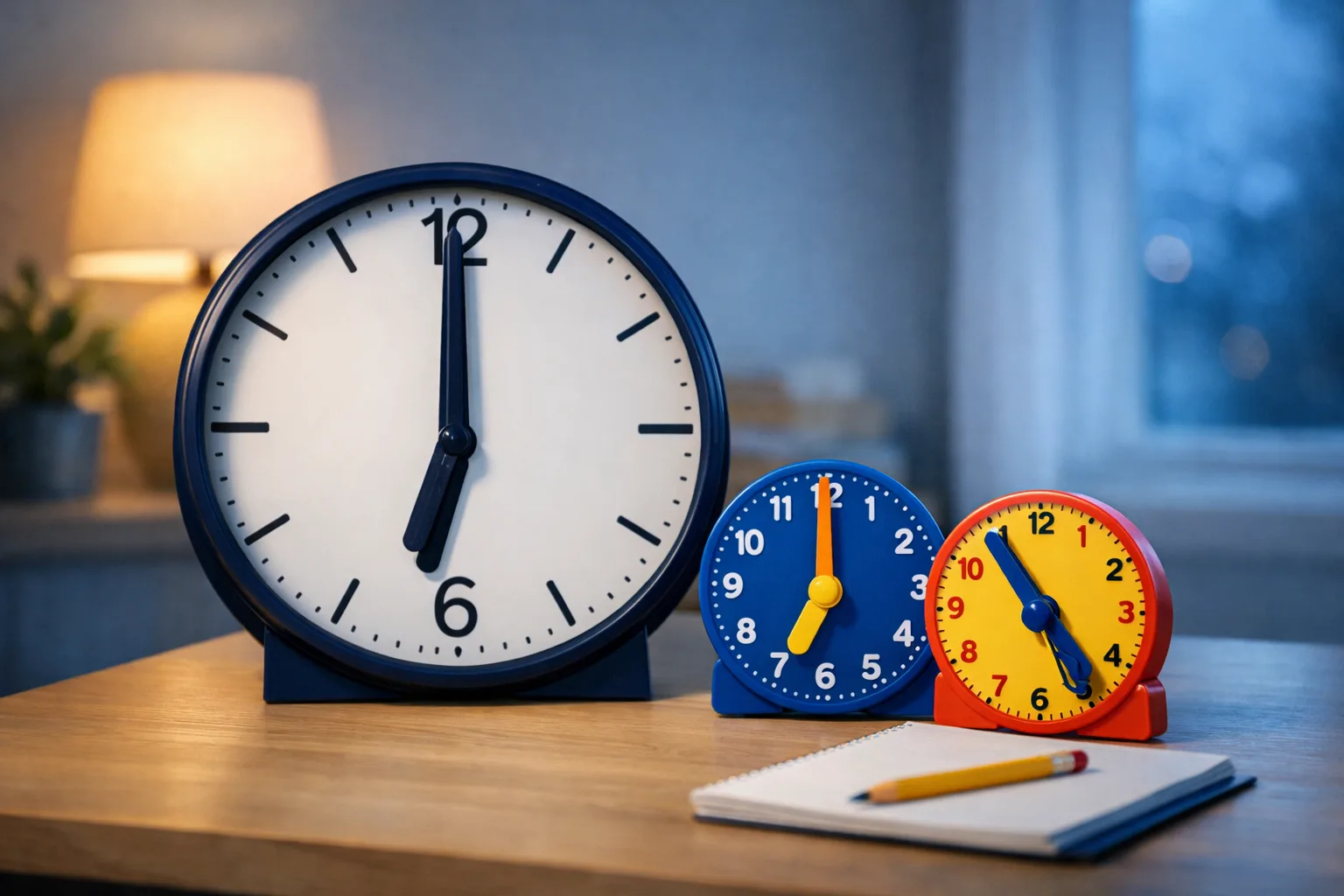
Every November, clocks across most of the country move back one hour, and everyone has to change at least one clock in the house. That small chore is a perfect chance to teach your child to read an analog clock, a skill many kids find harder than it looks.
A quick bit of background
Daylight saving time begins in March and ends on the first Sunday in November. The U.S. Department of Transportation (DOT) oversees the national time zones and the dates of daylight saving time. Children enjoy hearing the old rhyme “spring forward, fall back,” and it makes a nice memory hook for the fall change.
Step 1: make the change together
Gather the wall clock, the oven clock, and the old analog clock from the closet. Let your child turn the hands back one hour on the wall clock. Ask, “What time was it before? What time is it now?” This is simple subtraction, and it ties the number line to the clock face.
Step 2: learn the two hands
Point out that the short hand tells the hour and the long hand tells the minutes. Have your child say “short hand, hour” and “long hand, minutes” out loud a few times. Use a paper plate and two paper strips to make a practice clock, and mark the 12, 3, 6, and 9.
Five-minute daily exercises
- Show me. Say a time, such as 7:00 or 3:30, and have your child move the hands on the paper plate clock.
- Tell me. Set the clock and ask your child to read it. Start with o’clock times, then half hours, then quarter hours.
- Count by fives. Count around the clock face by fives to learn that the 3 means 15 minutes, the 6 means 30, and the 9 means 45.
- Wake-up challenge. Ask your child to read the clock at breakfast, after school, and at bedtime, and to tell you what time it is in words.
Keep it short and steady
Five minutes a day for two weeks will help far more than a long session once. Move on to “quarter past” and “quarter to” only after o’clock and half hour times feel comfortable. If your child is confusing the hands, put a small colored sticker on the short hand to help.
Many second and third graders are expected to tell time to the nearest five minutes, and later to the nearest minute. If your child is still struggling after several weeks of daily practice, ask the teacher what the class is working on. Ideas for math practice at the kitchen table are in the rest of Science and discovery too, where timing experiments are a favorite.
Leave a Reply