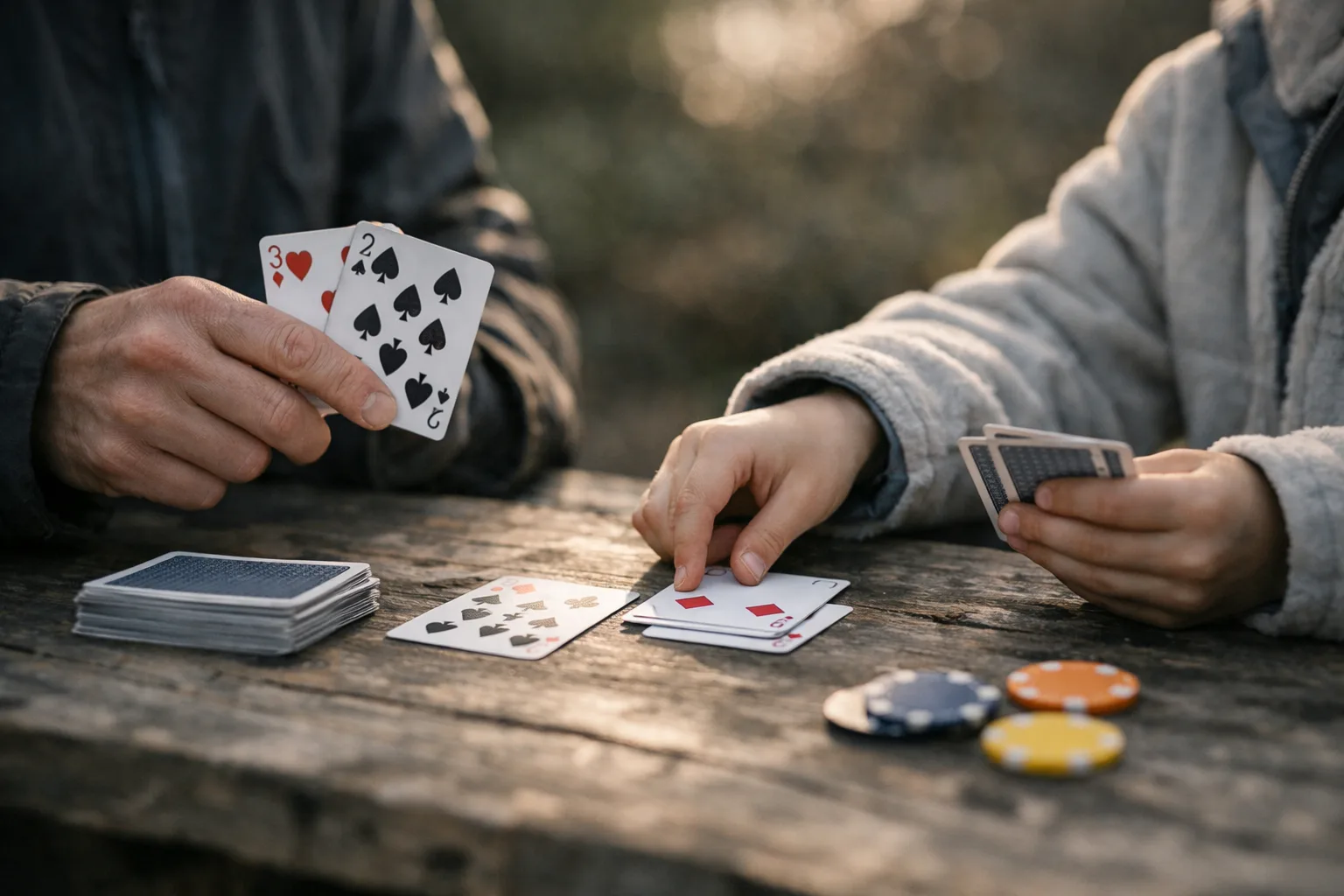
A deck of playing cards might be the cheapest math tool in the house. Numbers are printed on every card, the cards are easy to shuffle and deal, and the games are quick enough to play before dinner. If you have a child in grades 1 to 5, a deck can carry you through years of practice.
What fluency really means
The National Council of Teachers of Mathematics (NCTM) is the main professional organization for math teachers in the United States. In its published guidance, NCTM describes fluency as more than speed. It means working with numbers accurately, flexibly, and efficiently, and understanding why a method works. A game that asks your child to think about numbers in several ways builds that kind of fluency better than a timed drill.
Get the deck ready
Remove the jacks, queens, and kings, or keep them out of play as zeros. Aces count as 1. That leaves 40 number cards, from ace through 10, in four suits. For younger children, use only ace through 5 at first.
Games for addition and subtraction
Make ten
Lay out twelve cards face up. Players take turns finding two cards that add to 10, such as 3 and 7, and taking them. Replace the cards from the deck. The player with the most pairs wins. This game builds a strong sense of number pairs, which is a foundation for mental math.
Sum war
Each player flips two cards and adds them. The larger sum takes all four cards. For second and third graders, play with three cards each. For older kids, subtract the smaller card from the larger and compare differences instead.
Games for comparison
Classic war
Each player flips a card and the higher number wins both. It looks simple, and it is a good first game for kindergarten and first grade because it builds number sense and comparison.
Greater than, less than
Flip two cards each. Make the biggest two-digit number you can with your cards, then compare with your partner. Say the result aloud as a sentence, such as “Forty-two is greater than twenty-four.”
Games for multiplication
Multiplication war
Each player flips two cards and multiplies them. The larger product wins all four cards. Keep a list of the facts that cause pauses, and practice them separately the next day.
Product match
Flip a card to set a “target multiplier,” say 6. Deal cards one at a time and have both players race to call out the product when a card appears. Change the target after ten cards.
Adjust the level
- Younger or less confident: use fewer cards, allow counters, and play cooperatively.
- On target: use the standard rules and play for ten minutes.
- Ready for more: add three cards instead of two, add a rule such as “doubles score extra,” or ask for a “how did you figure it out?” explanation each turn.
The explanation matters. When your child says, “I did 9 plus 6 by taking 1 from the 6 and making it 10 plus 5,” that is flexible thinking, which is the real goal. Keep the mood light and quit while it is still fun. For a story-based evening that pairs well with a card game, take a look at Reading and literacy.
Leave a Reply