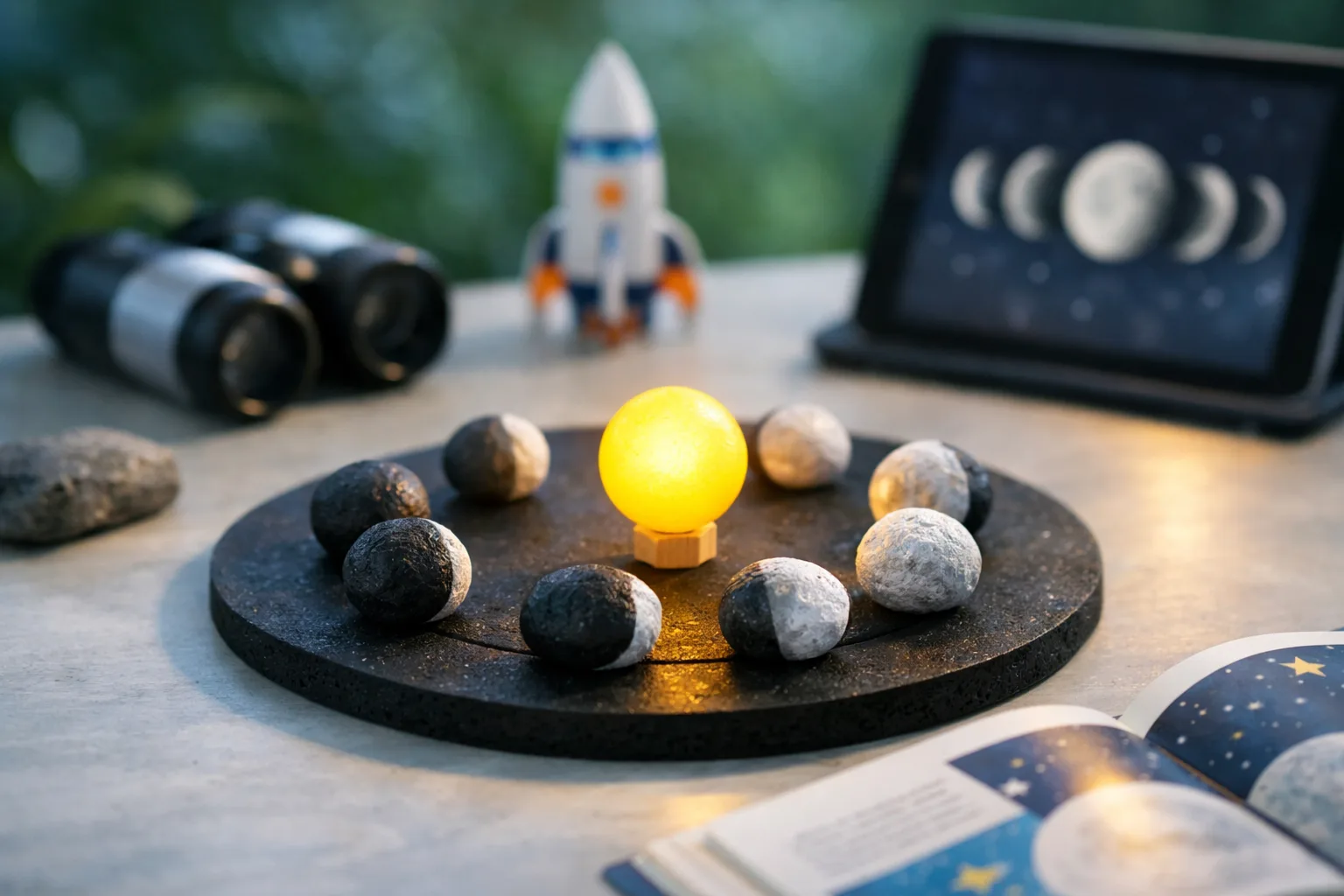
Few things in the sky are as easy to watch as the moon, and few are as puzzling to a child. Why does it look like a thin curve one week and a bright circle two weeks later? You can answer that question over one month with a notebook, a few clear evenings, and a household lamp.
Start with what NASA says
The NASA Space Place website is aimed at elementary-age kids and offers short explanations, games, and activities about space. NASA explains the moon phases this way:
The Moon does not make its own light. It shines because it reflects sunlight, and as the Moon orbits Earth, we see different amounts of its sunlit side. (Paraphrasing NASA)
That one idea clears up the most common mistake, which is thinking that Earth’s shadow causes the phases. The shadow of Earth only matters during a lunar eclipse, which is a rare event. You can read more on the NASA Space Place website.
A month-long moon journal
The moon goes through a full cycle of phases in about 29.5 days. Make a simple chart with one box for each day, and each evening ask your child to draw the shape of the moon. If the sky is cloudy, write “clouds” in the box. Do not fill in missing days with guesses.
Look for the moon at about the same time each evening, say after dinner. You will notice that it rises later each night. Some phases are also visible in the daytime, which often surprises kids.
Names to learn
- New moon. The moon is between Earth and the Sun and we cannot see it.
- Waxing crescent. A thin sliver grows on the right side (in the Northern Hemisphere).
- First quarter. Half the visible disk is lit.
- Waxing gibbous. More than half is lit and growing.
- Full moon. The whole face is lit.
- Waning gibbous. The lit part is shrinking.
- Third quarter. Half is lit again, on the opposite side.
- Waning crescent. A last sliver before the cycle begins again.
“Waxing” means growing and “waning” means shrinking. A memory trick: waxing moons are growing toward full.
Build a model with a ball and a lamp
Darken a room and set a bare lamp on a table, without the shade, to act as the Sun. Give your child a ball, such as a foam or tennis ball, to hold at arm’s length as the moon. Your child stands in the middle as Earth, holding the ball out in front, and slowly turns in a circle. Ask your child to watch the lit part of the ball.
When the ball is between your child and the lamp, you see the dark side, which is a new moon. When the ball is on the far side, the whole face is lit, which is a full moon. Try holding it at different points and ask your child to name each phase. Younger children may need a few tries.
Questions to ask
- “Why does the moon look different each night?”
- “How many days between full moons?”
- “Do you think the same side of the moon always faces us? How could we find out?”
If you do not see the moon on a given night, check an almanac or a weather site for the rise time. Always supervise children outdoors after dark, and keep the lamp’s bulb away from fabrics and hands, since it gets hot. For more writing ideas based on observation, try the notebook tips in Writing and language.
Leave a Reply