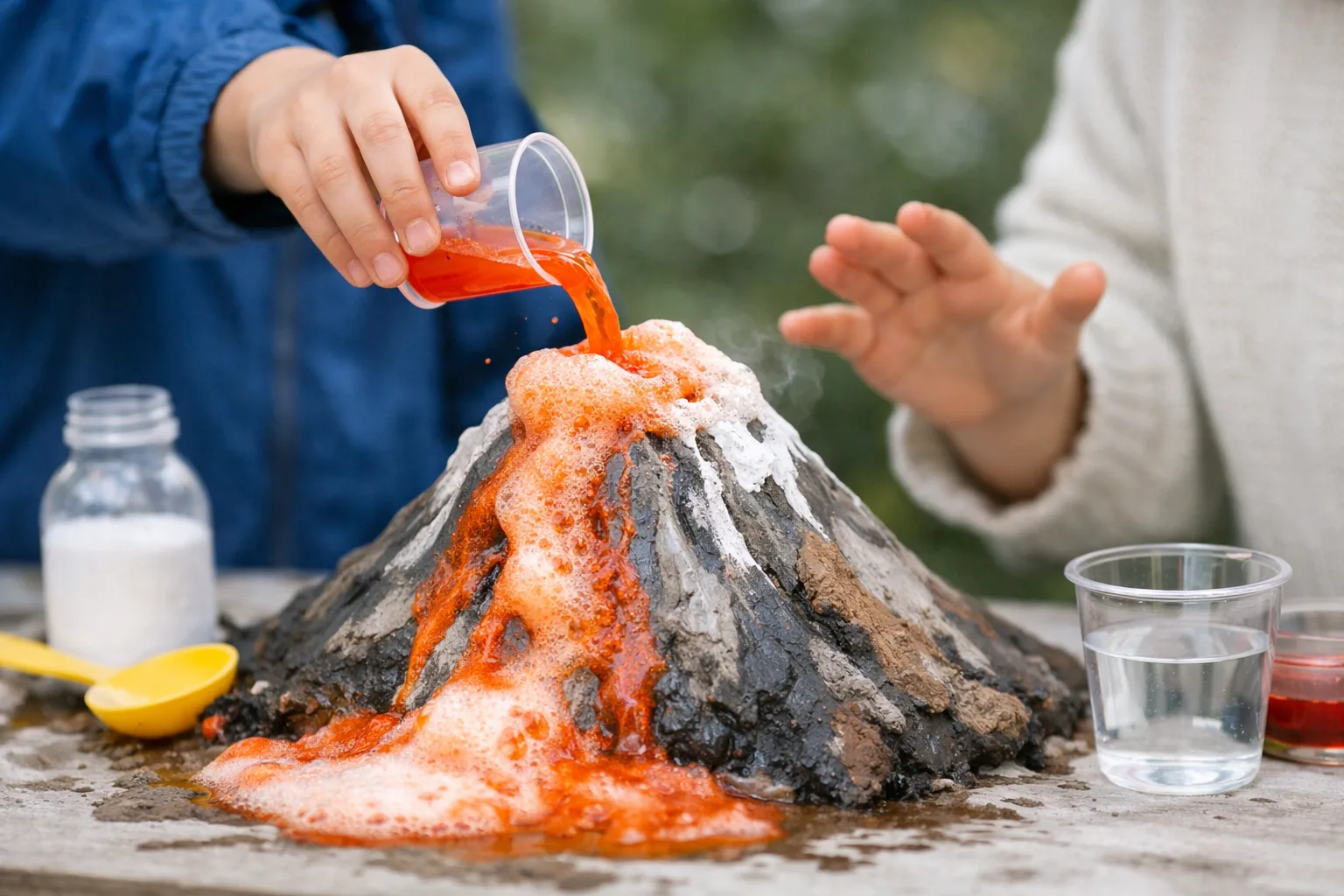
On May 18, 1980, Mount St. Helens in Washington State erupted with a force that flattened forests and sent ash across several states. The United States Geological Survey (USGS) monitors the mountain and other volcanoes, and its scientists track small earthquakes and gas to understand what is happening below the surface. At home, a few harmless eruptions can help your child see the basic idea of pressure building and releasing.
A word of honesty first. Vinegar and baking soda make a chemical reaction that produces carbon dioxide gas and foam. A real volcano erupts because of melted rock, called magma, and trapped gas. The kitchen version is a model, not the real thing, and that is worth saying out loud to your child.
Before you start
- Work outside or on a tray with edges, and wear safety glasses or sunglasses.
- Keep vinegar away from eyes, and wash hands afterward.
- Never seal the container. Gas needs room to escape.
- Keep a towel and a measuring cup handy.
Three eruptions to try
| Experiment | Materials | Time | What to observe |
|---|---|---|---|
| 1. Classic cone | Small bottle, clay or sand for the cone, 2 tablespoons baking soda, 1/2 cup (120 ml) vinegar | 10 minutes | How high the foam rises and how long it flows |
| 2. Slow and fast | Two cups, warm and cold vinegar, baking soda | 10 minutes | Which reaction bubbles faster, and why |
| 3. Thick lava | Baking soda, vinegar, a spoonful of flour, red food coloring | 15 minutes | How thick mixtures move more slowly |
Experiment 1: classic cone
Build a cone of clay or damp sand around a small bottle with the opening at the top. Put the baking soda in the bottle. Add a few drops of red food coloring to the vinegar and pour it in. Step back and watch. Have your child draw the eruption and measure how far the foam flows with a ruler.
Experiment 2: slow and fast
Use two identical cups with the same amount of baking soda. Pour warm vinegar in one and cold in the other. Ask your child to predict which will fizz faster before you pour. Warmer liquids usually react a little faster, but let your child record what actually happens, since results can vary.
Experiment 3: thick lava
Mix a spoonful of flour into the baking soda and add vinegar. The thicker mixture flows more slowly and piles up. Ask your child how this resembles a real volcano with thick, sticky magma, and why a thick eruption might be more explosive.
Keep a science notebook
For each test, have your child write a prediction, draw the result, and answer one question: “What changed?” Encourage numbers where possible, such as how many seconds the fizzing lasted. Change only one thing at a time so the comparison is fair.
Connect to the real mountain
After the experiments, look at photos of Mount St. Helens before and after 1980 in a library book, and talk about how scientists watch volcanoes today. Ask, “What would you measure if you were a volcano scientist?” For another hands-on project that brings the outdoors to your table, check the nature notebook tips in Writing and language.
Leave a Reply