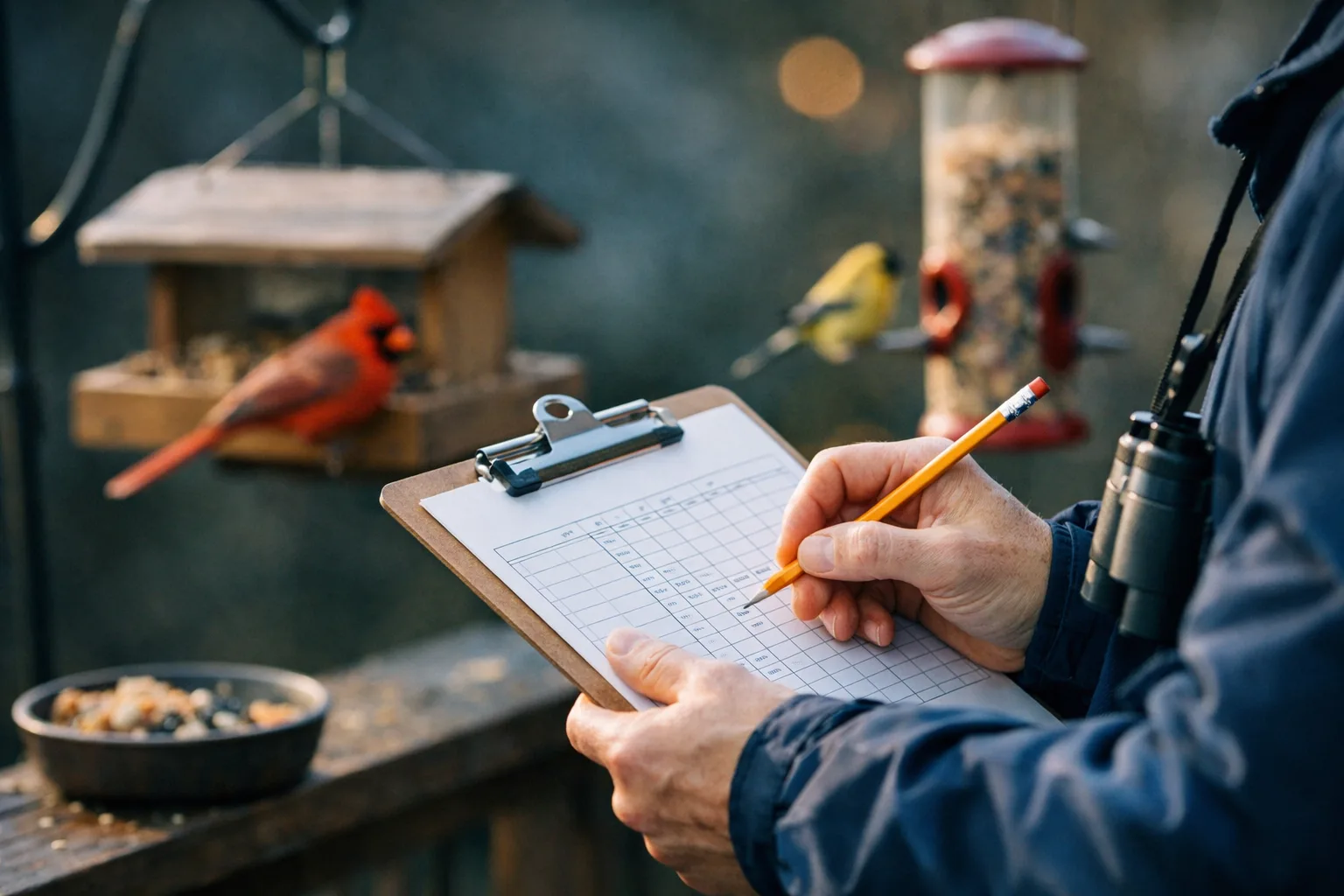
A bird feeder outside a kitchen window is one of the easiest science labs a family can build. It costs little, it runs all year, and every day brings something to see. With a notebook and a bit of patience, your child can learn to identify birds, spot patterns, and even contribute observations to real research.
What Project FeederWatch is
The Cornell Lab of Ornithology runs Project FeederWatch, a citizen-science program in which people across North America count the birds that visit their feeders and report what they see. The counts happen during the colder months, roughly November through early April, and scientists use the data to study how bird populations shift over time. Anyone with a feeder can take part, including families. You can learn more at the Project FeederWatch website, which explains how to sign up and what to count.
You do not have to enroll to start watching. Many families begin on their own and decide later whether to join.
Set up your station
Choose a spot
Place the feeder where you can see it from a window, ideally about 10 feet (3 m) from shrubs or trees so birds can escape from predators, but not so close that cats can hide. To reduce window strikes, put the feeder either very close to the glass, within about 3 feet (1 m), or well away from it, more than about 30 feet (9 m).
Pick the food
Black-oil sunflower seed attracts many common species. A tube feeder suits small birds like finches, while a platform feeder welcomes cardinals and juncos. Start with one feeder and one kind of seed. Add more variety once birds are visiting regularly.
Keep it clean
Dirty feeders can spread disease among birds. Empty old seed, scrub the feeder every couple of weeks with hot soapy water, rinse it well, and let it dry before refilling. Cornell Lab and other bird groups offer detailed cleaning guidance, including a mild bleach rinse. An adult should do the cleaning, and everyone should wash hands afterward.
Start a bird journal
Give your child a small notebook and a pencil. Each entry can include the date, time, weather, and a quick sketch of each bird that visits. Add notes about color, size compared with a sparrow or a robin, beak shape, and behavior. Number the birds that come together, since counting is exactly what citizen scientists do.
Keep a pair of binoculars handy. A child-sized pair is fine, and the free field guides at the library are a good place to look up what you saw.
Five common birds to learn first
- Northern cardinal. The male is bright red with a crest and a black face. The female is tan with red touches. Cardinals often visit at dawn and dusk.
- Black-capped chickadee. A small, curious bird with a black cap and bib. It grabs a seed and flies off to eat it elsewhere.
- Dark-eyed junco. Often called a “snowbird,” it has a gray or brown back and a white belly, and it feeds on the ground.
- Blue jay. Large, loud, and blue with white and black markings. It may carry away peanuts.
- American robin. A familiar bird with an orange-red breast. Robins prefer worms and fruit to seed, so you are more likely to see them on the lawn than at a feeder.
Not every region has all five, so ask your local library for a field guide to birds in your area.
A season-by-season plan
Fall: get ready
As the weather cools, set up the feeder and clean it. Many birds migrate through in fall, so you may see unfamiliar visitors. Record the first day you see each species.
Winter: count
This is the prime time for feeder watching, because natural food is scarce. Pick a regular watching day, and count the greatest number of each species that you see at one time. This method avoids counting the same bird twice, and it is the approach FeederWatch uses. Keep a tally in your journal.
Spring: watch for change
Migrants return, and some birds change their colors and songs. Watch for nest-building behavior, but keep a respectful distance from any nests. Listen for new songs and describe them in your journal in your own words.
Summer: look beyond the feeder
Feeder traffic often drops when insects and berries are plentiful. Use this time to take a walk and see where birds nest and feed. Add a shallow birdbath, and watch for parents bringing young to the water.
Make the watching a family habit
Choose a short, regular time, such as ten minutes before breakfast, and let everyone share a job. One person is the spotter, one is the recorder, and one is the weather reporter who writes down the temperature and whether it is sunny, cloudy, or snowy. Rotate the jobs each week so nobody gets bored. A small whiteboard near the window works well for quick tallies that can be copied into the journal later.
Patience is the main skill here. Some mornings the feeder will be busy, and other mornings it will be quiet. Both are useful data. A child who learns to write “zero birds today” without disappointment is thinking like a scientist, because an empty count tells you something too.
Safety and kindness
Watch from inside or from a distance, so the birds feel safe. Never touch a sick or injured bird, and do not try to handle wild birds yourself. If you find one in trouble, call a local wildlife rehabilitator. Keep cats indoors if you can, since feeders attract birds right into easy reach. These habits teach children that watching wildlife comes with responsibility.
Questions for your child
- “Which bird do you see most often? Why might that be?”
- “Does the number of birds change when the weather changes?”
- “What is your favorite bird’s beak shaped like, and what does that help it eat?”
Looking back after a year
At the end of twelve months, spread out your notebook pages and count together. Which birds came in every season? Which disappeared? Make a simple bar chart on paper. That chart is real data, which is what scientists use, and it is a powerful way for a child to see that careful, patient observation tells a story.
If your child enjoys writing about what they notice, see the Writing and language section for journaling ideas that go well with a bird notebook.
Leave a Reply