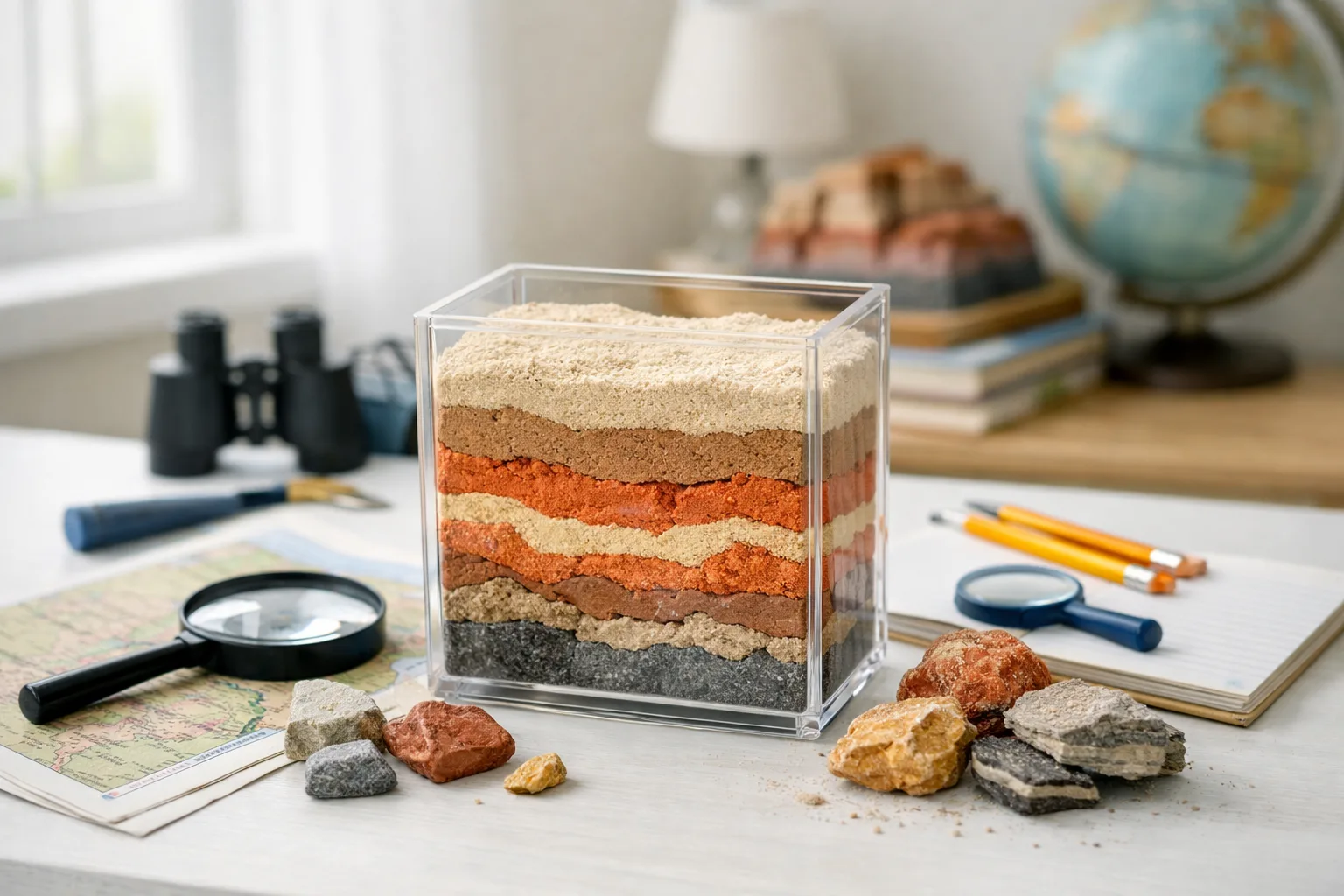
Most fourth graders have heard that the Grand Canyon is huge. Fewer realize that it is also a giant book with the pages showing. Each band of color in the canyon walls is a layer of rock that formed at a different time, so the canyon lets you read Earth’s past from the top down. That makes it one of the best examples for a grade 4 lesson on layers, time, and erosion.
The big idea in plain words
Rock layers, or strata, usually form from the bottom up. Sand, mud, and shells settle, pile up, and slowly harden into stone. The older layers lie underneath, and the younger layers sit on top. Over a very long time, the Colorado River cut down through the layers and carved the canyon, which is why we can now see them from the rim.
According to the National Park Service, Grand Canyon National Park in Arizona protects a canyon that is about 277 miles (446 km) long and more than a mile (1.6 km) deep. The rocks exposed in its walls record a span of roughly two billion years. Ask your child to say that number out loud and then compare it to something they know, such as their own age. It does not need to make sense yet. The goal is to feel how big it is.
A kitchen experiment: build your own layers
You will need a tall clear glass or jar, three or four different dry materials, and a spoon. Good choices are sand, flour, dry rice, crushed cereal, and cocoa powder. Choose materials with clearly different colors.
- Have your child spoon in the first material until it covers the bottom by about an inch. Explain that this is the oldest layer.
- Add a second color on top, then a third, then a fourth. Each one is a younger layer.
- Look at the jar from the side. Ask: which layer is oldest? Which is youngest?
- Now take a spoon and carefully scoop a narrow channel down one side, as a river would. Notice that you can see every layer in the cut.
That cut is a tiny canyon. Ask your child to draw it and label the layers from oldest to youngest. If the jar is slightly tilted while you scoop, the layers may slide, and that is a chance to talk about how real rock can shift, fold, and crack over time.
Questions to ask
- If a fossil is found in the lowest layer, is it older or younger than one found near the top?
- Why can we see so many layers at the Grand Canyon but not in our own backyard?
- What do you think the river did to the rock over millions of years?
Keep the answers short and let your child do the thinking. If the questions come back unanswered, look them up together.
Use the park’s own materials
The park maintains a website with photographs, maps, and explanations of the rock layers, plus programs for young learners such as the Junior Ranger activities. Reading just one page together out loud, and finding two facts to add to your child’s notebook, is enough for this lesson.
You can also pair the activity with a short writing task. Ask your child to write three sentences beginning with “If I stood at the bottom of the canyon, I would see…” That ties the science back to your writing and language practice and gives you something to hang on the refrigerator.
Leave a Reply